
Aortic Valve Fenestrations
Who knew?


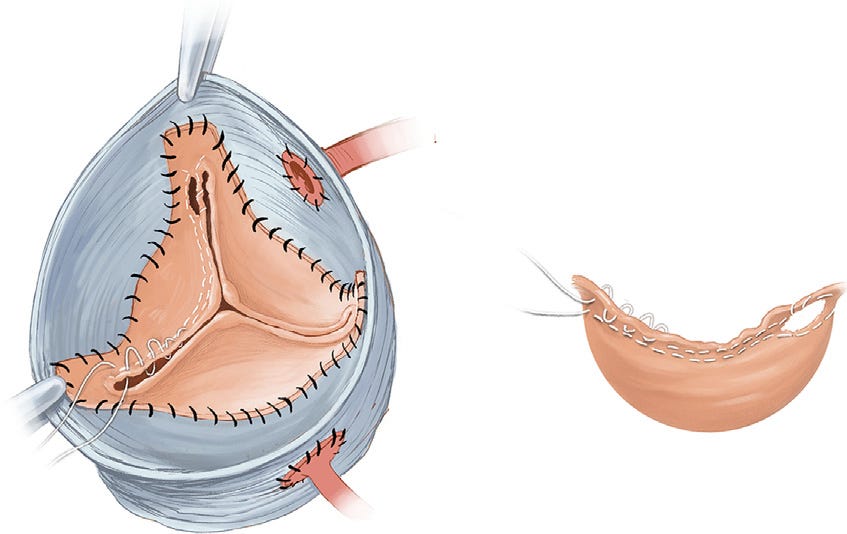
Figure 1. An aortic valve fenestration illustrated in the setting of reimplantation of an aortic valve (David operation) from David et al.
I am joined in this post by Dr. Scott DeRoo, Assistant Professor of Surgery at the University of Washington. Dr. DeRoo specializes in aortic valve repair and replacement and reconstruction of the ascending aorta.
Recently I anesthetized a patient with an ascending aorta aneurysm for a David operation (aortic root replacement with preservation of the native aortic valve) and replacement of the ascending aorta and hemiarch. We thought the aortic valve was entirely normal based on both the preoperative transthoracic echocardiogram and the intraoperative prebypass transesophageal echocardiogram. The aortic valve was trileaflet, the leaflets were thin and pliable, there was no calcification, and there was only the tiniest central aortic insufficiency. However when my surgical colleague, Dr. Scott DeRoo examined the aortic valve after opening the aortic root, he found numerous FENESTRATIONS in the commissural, and central regions of the valve.
Say what? Fenestrations? I had no idea what these fenestrations were about, and I’ve been doing this for a while. After the case I asked several cardiothoracic anesthesia colleagues and cardiology imaging specialists whether they knew what an aortic valve fenestration is. They all had the same puzzled look on their faces.
So it seemed like a good topic for a Substack post.
Aortic valve fenestrations are defined as any gap or hole of at least 1 mm in diameter (Figure 2). They are regarded as a subclinical congenital condition and are remarkably common, occurring in approximately 50% of people. They tend to be located in clusters at the free edges of the leaflets near the commissures but can occur anywhere in the leaflet. They can be associated with leaflet prolapse or aortic regurgitation, although typically leaflet function is normal. Fenestrations are not usually identifiable with either transthoracic or transesophageal echocardiography due to insufficient spatial resolution. Computed tomography (CT) imaging is better suited for detecting fenestrations.
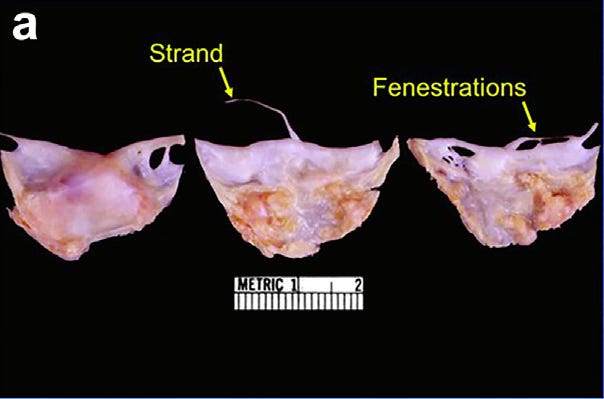
Figure 2. Surgical specimen of an aortic valve with fenestrations (Kurmann et al)
Whether to repair (by reinforcement of the leaflet edge with running Gortex suture—Figure 1) or ignore fenestrations during aortic valve sparing operations is unclear. In some cases, replacing the valve with a prosthetic valve may be preferable to repair. David et al reported in a retrospective analysis of aortic valve reimplantation that the long-term outcomes of valves with repaired fenestrations was similar to that of valves without fenestrations, however extensive long-term data is lacking.
Dr. Scott DeRoo provides us with the surgeon’s perspective
Given the challenges associated with studying a condition not detectable on modern non-invasive imaging, the natural history of aortic valve fenestrations remains nearly completely unknown. Although occasionally considered congenital, many fenestrations are suspected to be acquired, often associated with stretching and thinning of aortic valve leaflets in the setting of an aortic root aneurysm. Previous work has demonstrated that the greatest points of stress in an aortic valve are concentrated at the commissural attachments, and therefore it doesn’t seem to be much of a stretch of the imagination to assume that fenestrations often represent a relative imbalance between commissural leaflet integrity and repeated stress. In short, elongated, stretched out, and thin aortic valve leaflets are liable to develop small commissural fenestrations over time, but how far these evolve and their effect on valve function remains unknown.
Most surgeons will tolerate some degree of fenestrations when considering whether to repair an aortic valve. Fenestrations that are limited to the commissural region of the valve, those that extend less than 1/3 of the distance to the center of the leaflet free-edge, and those limited to 1-2 commissures are often considered to have limited effect on valve durability and ability to repair (this is admittedly based largely on “expert opinion”). In the setting of particularly large fenestrations or those that extend to the midpoint of the leaflet free margin, surgeons are often understandably hesitant to offer repair. In cases where repair is strongly preferred, many surgeons will reinforce the free margin of the leaflet with a small Gore-Tex suture, a technique pioneered by Dr. David himself.
Although conceptually straightforward, the process of free-margin reinforcement is often fraught with potential errors, as even a slight amount of tension in the reinforcing suture will restrict leaflet motion and lead to aortic insufficiency. Gore-Tex is by also design slippery and tying knots that stay firmly in their desired location can be frustrating even for experienced surgeons. Technical difficulties associated with the use of Gore-Tex aside, it is also unknown whether correction of associated aortic root aneurysm and restoration of normal root geometry will decrease commissural leaflet stress, and whether this is likely to “arrest” the process of fenestration formation. Is a rebuilt valve subject to the same stress as one located in a root aneurysm? Does a non-distensible root (the Dacron graft we use to replace the aortic wall) actually result in increased leaflet stress? Will the fenestrations grow over time? Will the superior “bridging segment” of the fenestration tear leading to catastrophic AI? Does any of this matter clinically when it comes to valve function and durability? Honestly, we aren’t sure.
Consideration of whether to undertake valve repair in any setting must balance the reported benefits of native valve preservation with the likelihood of early valve failure. Circling back to our patient, the decision to replace the valve was multifactorial. Yes, the valve had multiple fenestrations, but he was also 67 years old with multiple medical comorbidities such that his life expectancy could reasonably be assumed to be less than 15 years. Had he been 40 years old and in otherwise good health, we certainly would have opted for repair with Gore-Tex free margin reinforcement.
Fenestrations aside, the resection of otherwise generally healthy leaflets always makes a valve repair surgeon cringe. However, in a much broader sense, it’s important that we carefully consider the best interest of the patient when making the decision to repair or replace. All of us that do valve repair want to repair valves, but it’s important to ask if we’re really doing it for the patient, or because we really want to do a repair. A valve-sparing root replacement that results in significant aortic insufficiency after just a few months or years has certainly not yielded the desired outcome, and ultimately is likely to offer worse results than an up-front replacement. Ensuring valve competency in repair often requires use of a smaller size graft than would be implanted with a root replacement, thus potentially limiting the size of a future TAVR. Although a thorough discussion of the benefits of aortic valve repair over the age of 65 is a whole different can of worms, the expansion of valve repair to older patients does force us to confront the issue of aortic valve fenestrations. Unfortunately, like most things in our specialty, we are left to make difficult decisions with incomplete information. Likely for younger patients it’s reasonable to tolerate some degree of valve fenestration as the benefits of repair outweigh the risks of outright replacement. In older patients, the opposite is true.
In the absence of high-quality long-term data, experience and clinical judgement are key in weighing whether to offer valve repair. Ultimately, fenestrations are one more data point out of many when assessing whether repair should be undertaken. Like many incompletely understood biological phenomena, the story of aortic valve fenestrations is shrouded in mystery – in fact you might say it’s full of holes.
 | A guest post by
|