
The classic experiment (1959) demonstrating that tuberculosis is airborne has now been repeated for SARS-CoV-2
There was little doubt that COVID is airborne. Now there is even less.


For this post, I am joined by Dr. Lisa Brosseau, a renowned expert on respiratory protection, who is affiliated with CIDRAP at the University of Minnesota. Dr. Brosseau has collaborated with us on several articles that can be found here, here and here.
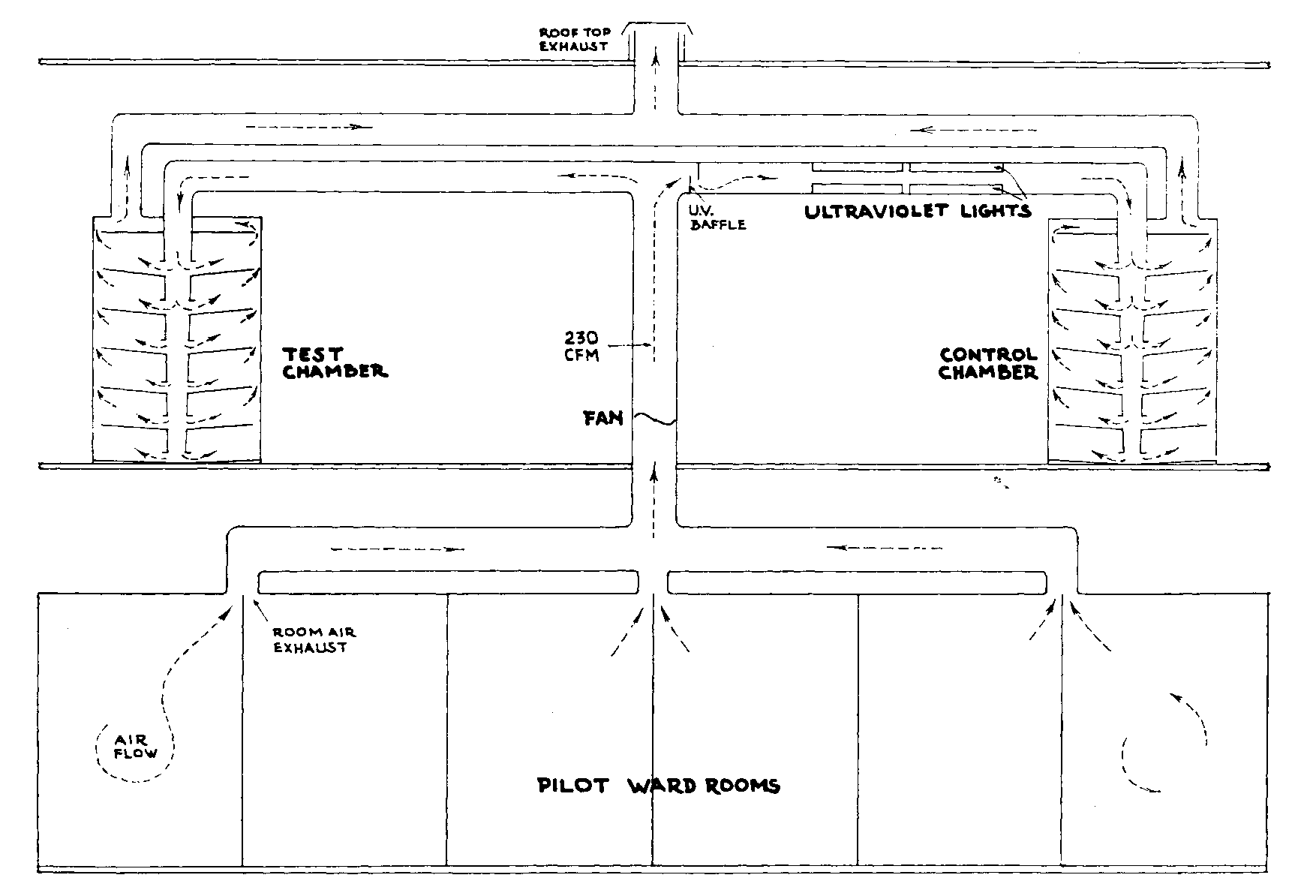
Figure 1. A schematic diagram of the experiment in which air from rooms housing tuberculosis patients was piped to a separate location to expose guinea pigs. As an option, the air could be treated with ultraviolet light prior to reaching the animals.
The classic tuberculosis experiments of Wells and Riley
Wells, his protégé Riley and their coworkers performed the seminal experiments demonstrating unequivocally that tuberculosis is airborne and published the results in 1959. In 1962, Riley et al published a follow-up study. They demonstrated that ultraviolet light could destroy the airborne tuberculosis bacteria, and that some patients were “superspreaders” of tuberculosis. These experiments were conducted by piping the air from a ward containing tuberculosis patients to a remote location containing cages with guinea pigs. Care was taken to have no contact between the tuberculosis patients and the guinea pigs except for the sharing of air. The guinea pigs contracted tuberculosis. However, when the air was treated with ultraviolet light prior to reaching the guinea pigs, no guinea pigs were infected. These are classic, historic experiments that established convincingly that tuberculosis is airborne, and can cause infection at a substantial distance from the source.
The classic study design of Wells and Riley, repeated for SARS-CoV-2
As noted in a previous post, SARS-CoV-2, the etiologic agent of COVID-19, is also airborne. The evidence for this is substantial. However, debate about this has continued in some places; the CDC and WHO have equivocated about whether SARS-CoV-2 is airborne since the beginning of the COVID pandemic, and continue to equivocate about the significance of airborne transmission of respiratory pathogens in general. Roy et al have just published a paper in which they report the results of experiments with SARS-CoV-2 that are analogous to those performed by Riley and Wells with tuberculosis more than 65 years ago. They exposed hamsters to air from a physically separate area housing patients with active COVID. Following the exposure, the majority of the hamsters had antibodies to the spike protein of SARS-CoV-2. While there remains a small possibility that the antibody response seen in the hamsters could have occurred from an unrecognized prior exposure, this appears to be unlikely, as noted by the authors.
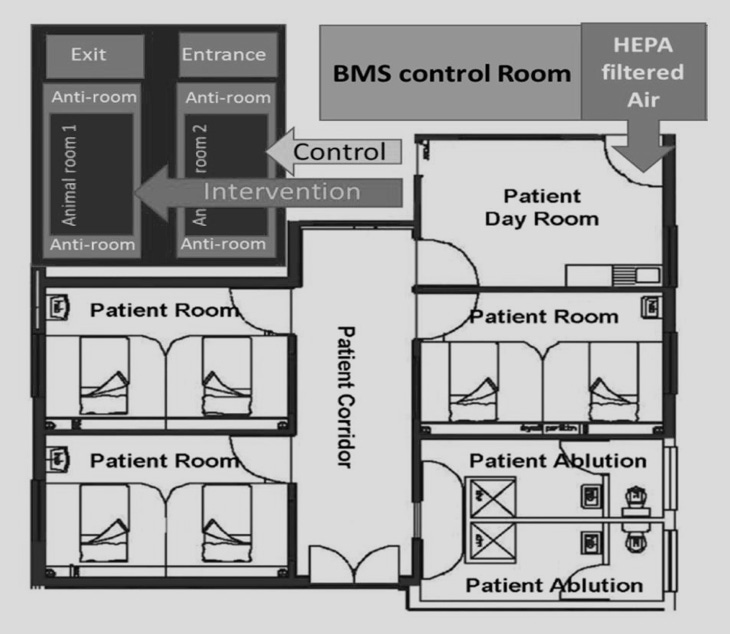
Figure 2. A schematic diagram of the experiment in which air from rooms housing COVID patients was piped to a separate location to expose hamsters. The facility was originally designed to study tuberculosis, but was repurposed to study SARS-CoV-2 airborne transmission.
It is remarkable that more than 65 years after Wells, Riley and their coworkers performed their classic studies of tuberculosis transmission, that we are still debating the significance of airborne transmission of a variety of respiratory pathogens, and even performing studies that resemble closely those performed by Wells and Riley.