
The Flight of Apollo 13 and Accidental Depowering of a Drager Apollo Anesthesia Machine – What Do They Have in Common?
Human Factors Design for Spaceships, Aircraft and Anesthesia Machines


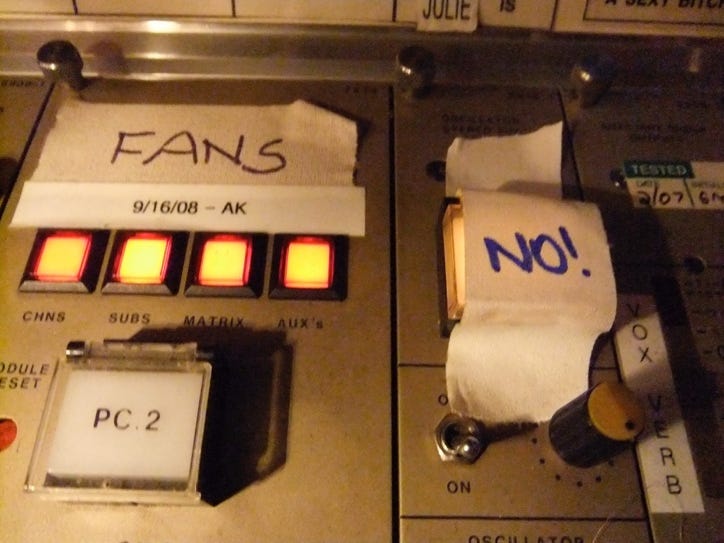
The crippled Apollo 13 spacecraft limped back to earth. Jack Swigert, the Command Module pilot taped a handwritten note over the toggle switch for jettisoning the Lunar Module, writing "NO!" to ensure he did not accidentally press it. Activating this switch prematurely could have separated the Lunar Module from the Command Module while both were still connected and pressurized, which would have been fatal for the crew. Swigert took this precaution because the crew was exhausted, cold, and under extreme stress, increasing the risk of a critical mistake.
I am joined in this post by University of Washington anesthesiologists Dr. Srdjan Jelacic, Dr. Jorg Dziersk, Dr. Wil VanCleve and Boeing test pilot Captain Dan Boorman. And with a photo contributed by our colleague Dr. Mark Edwards from Auckland NZ.
Depowering an anesthesia machine in the middle of an anesthetic, by pushing the power button by mistake, can produce a significant crisis. Hopefully, you will be able to ventilate the patient’s lungs manually until the machine can be restarted. It’s always a good idea to have a self-inflating bag (e.g. Ambu bag) immediately available in case of a catastrophic anesthesia machine failure. Our pre-induction anesthesia checklist*contains a “Primary and backup airway devices” item, prompting the anesthesia provider to confirm that a self-inflating bag is present along with a bougie, extra laryngoscope handles and blades and supra-glottic airways.
One of us experienced an accidental depowering of an anesthesia machine recently when the corner of the tray holding the electronic medical record keyboard accidentally bumped into the power switch on the front of a Drager Apollo anesthesia machine, turning it off (see photo below). Turning the anesthesia machine back on is not instantaneous. Pushing the power button activates a startup sequence that takes some time. Essentially, the process is rebooting a computer. This time may be on the order of a minute or less, but it could seem like an eternity.
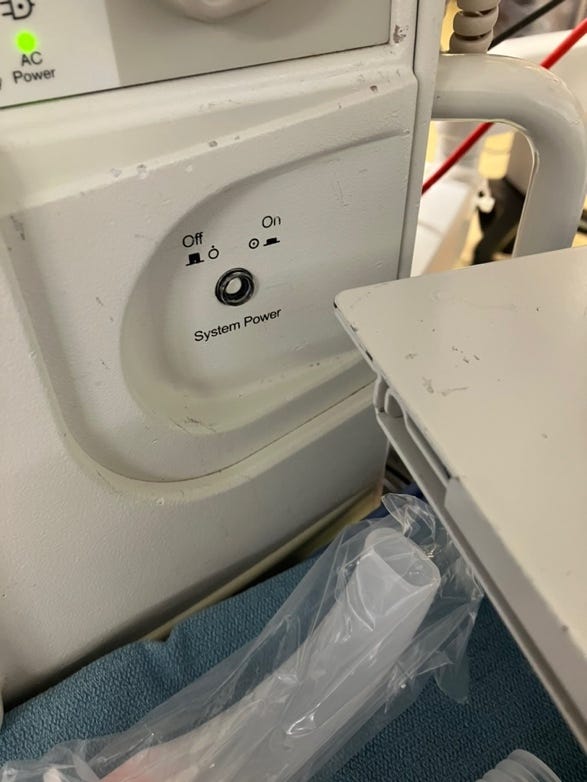
The corner of the electronic medical record keyboard tray is pointed at the power button of a Drager Apollo
Speaking with colleagues, we realized that this had happened to others. It was not a “one off”.
We have three different models of Drager anesthesia machines in our hospital. So the examples we give here are mostly for these machines. Other machines may be different. We don’t mean to focus any criticism on Drager machines in particular.
The Drager Apollo machine has a button on the front of the machine to turn it on and off. It’s close to the work surface of the machine, and it’s easy to imagine bumping it accidentally. When the machine is turned off, there is a brief countdown that is displayed on the machine’s screen, and an audible beeping sound (see video). If the power switch is pressed again during the countdown, the power down sequence is aborted
This is a reasonable layer of protection, but not foolproof. It would be entirely possible to miss the screen display and the audible alarm if distracted or focused on something else.
The Fabius power switch is on the back of the machine, is not covered or protected in any way, and could easily be bumped. When the Fabius is turned off, there is no warning and no delay. The machine is off.
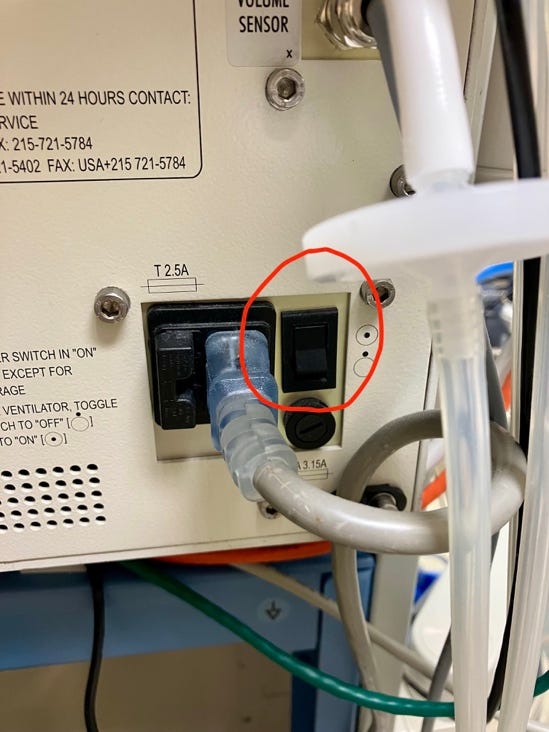
The Fabius power switch, on the back of the machine
The Atlan power switch is also on the back of the machine. It is in a recessed area and there is a piece of metal that appears intended to prevent it from being bumped, but it’s not completely covered. When the Atlan is turned off, there is no delay and only a high-pitched tone for a few seconds.
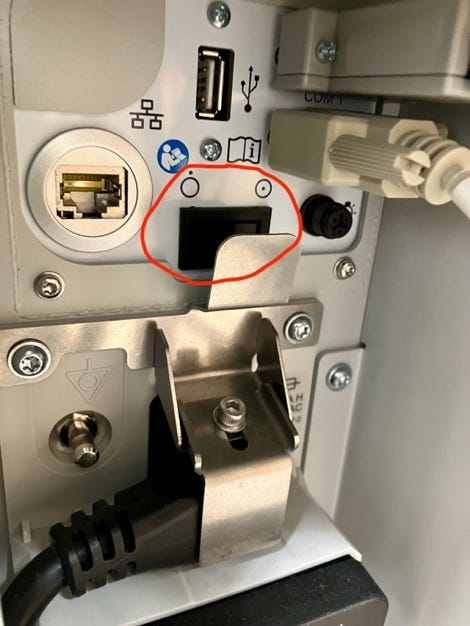
The Atlan power switch on the back of the machine
We were able to initiate manual ventilation (simulated) with all three of these machines after the power was turned off.
Fundamental human factors considerations would suggest that a critical function, like depowering a machine, should require at least two actions. In this instance, these anesthesia machines require only a single action to shut down. Covering the switches with a plastic cover (see photo) adds a second action. Raising the switch cover is one and pushing the switch is a second action. Boeing commercial airplanes utilize switch covers for functions that could present a safety hazard and are irreversible, including generator disconnect, ram air turbine deployment, and fuel jettison (see photo).
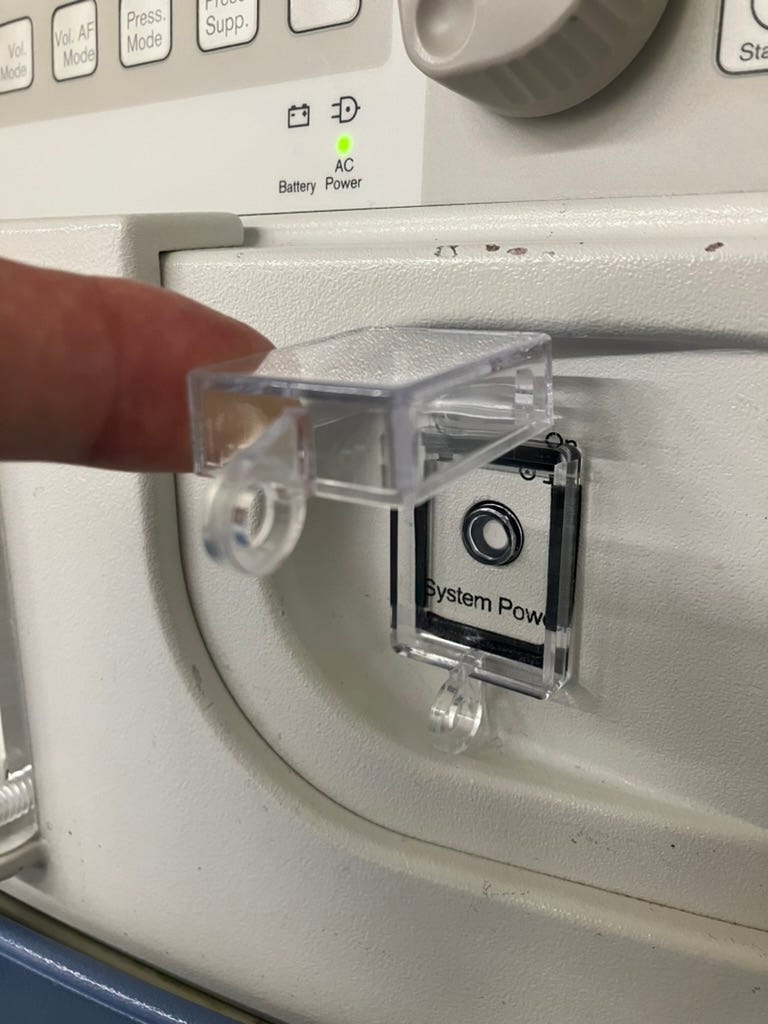
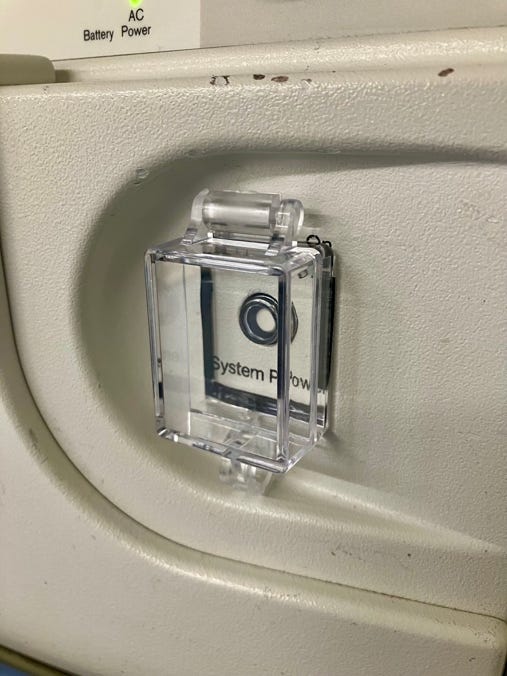
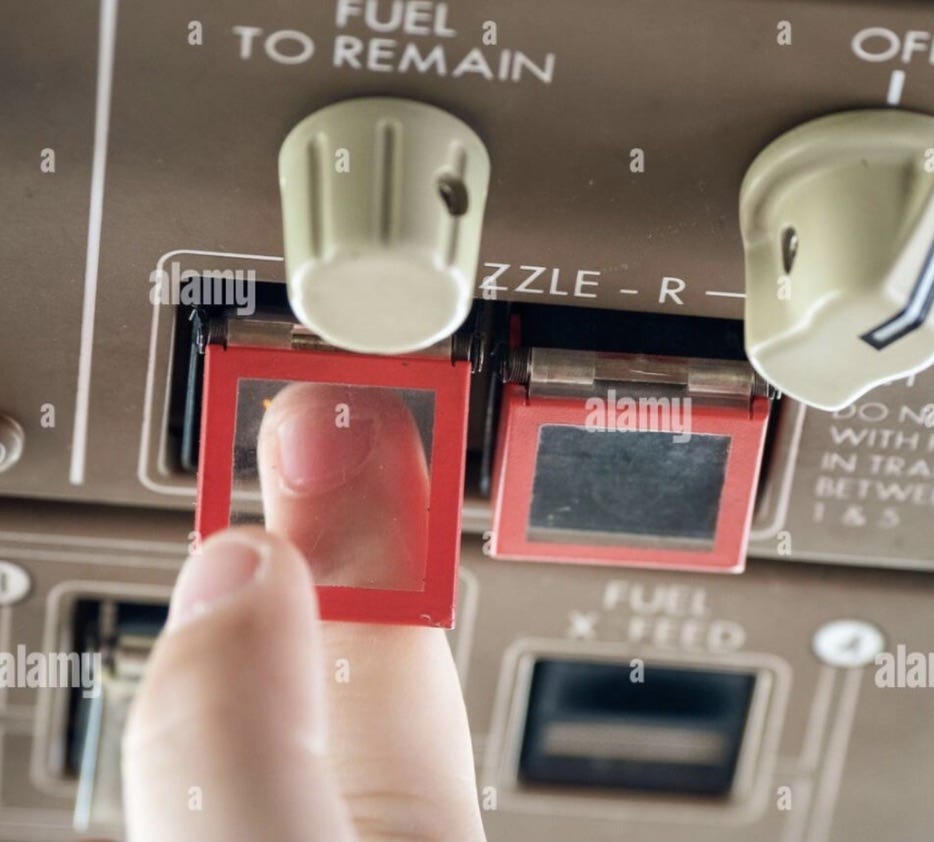
Above, aftermarket switch covers on the power button of a Drager Apollo machine. Bottom, a flight deck switch cover
Another example of a power switch cover on an anesthesia machine is shown below, in this case found on a Datex-Ohmeda machine.
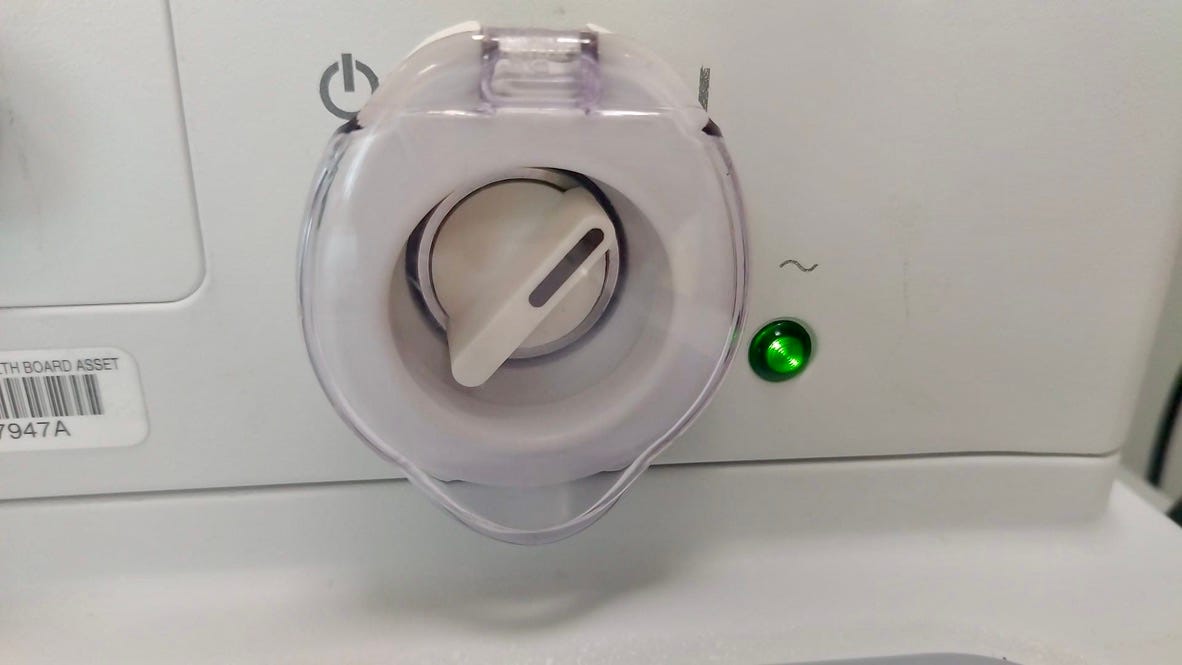
Power switch cover on a Datex-Ohmeda machine. Photo by Dr. Mark Edwards, Auckland New Zealand
In the movie Apollo 13, there is a scene in which one of the astronauts improvises a cover for a switch with the word “NO” written on it to make sure he won’t accidentally jettison the Lunar Excursion Module from the Command Module (see video below and photo above).
We believe that accidentally depowering an anesthesia machine, while a fairly unusual event, is dangerous. We think that covering the power switch with a hinged plastic cover, as illustrated above, is an inexpensive and effective means to help prevent a potential disaster.
* The pre-induction anesthesia checklist is one of several checklists available in the Checklist Navigator app
 | A guest post by
|
 | A guest post by
|
 | A guest post by
|
 | A guest post by
|