
Paralyzed while awake. Part 2
Paralyzed, awake volunteers can have low BIS or Entropy numbers typically seen during general anesthesia. Why?

Today’s post a little bit complicated. Hopefully you can plow through the technical detail to the conclusion, which involves what I think is a highly relevant clinical issue. Please let me know what you think in the comments.
In “Paralyzed while awake. Part 1” I reviewed the interesting literature describing deliberate paralysis in awake volunteers. There are numerous useful lessons from this research, including the not surprising observation that being paralyzed while awake can evoke intense anxiety, even in well informed volunteers.
In this post, I am going to focus on computerized electroencephalographic (EEG) analysis during paralysis in awake volunteers, in particular 3 papers that found unexpectedly low bispectral index (BIS) or Entropy numbers, in the range typically seen during general anesthesia (i.e. <50-60). I will suggest some possible interpretations of these findings.
Important fundamentals of computerized EEG monitoring
But first let’s go over a bit of background information. There are several commercially available algorithms for assessing “anesthetic depth” using computer analysis of EEG, including BIS, Entropy and Sedline. All of these algorithms generate a number, ranging from 0 to 100 (often referred to as an “index”), with a number <60 (BIS, Entropy) or <50 (Sedline) being the target for general anesthesia. The BIS algorithm is by far the most extensively described and tested, and there at least 6 clinical trials demonstrating that the use of BIS monitoring can reduce the incidence of unintended intraoperative awareness. I critically reviewed these studies in a chapter in Lee Fleisher’s “Evidence-Based Practice of Anesthesiology” (also see table below). To the best of my knowledge there are no such studies of intraoperative awareness for Entropy or Sedline.
It is important to understand that the EEG resulting from general anesthesia is not “pathognomonic” for anesthesia. In other words, the EEG changes produced by anesthetic drugs that result in a particular number in the index can also be seen in non-anesthetic states, including natural sleep. In addition, different anesthetic drugs produce different EEG effects. For example, ketamine has an unusual EEG signature amongst anesthetic drugs, that is not accounted for by the algorithms. Nitrous oxide produces little or no change in the EEG despite its significant anesthetic effects. Therefore, when interpreting the output of computerized EEG analysis it is critically important to know the CONTEXT, including what anesthetic drugs are being administered. An extreme example illustrates this point. A patient under anesthesia and a person who is asleep might both have a BIS index number of 60. However, if we cut both with a scalpel, the patient under general anesthesia will usually remain asleep, while the person who is sleeping will wake up immediately.
Another important concept is that the frequency spectrum of the electromyogram (EMG) originating in the scalp and face muscles near our EEG monitoring electrodes overlaps with the EEG frequency spectrum. This poses a very substantial challenge to interpretation of EEG. Because the overlap between EMG and EEG is greater at the higher frequency end of the EEG spectrum, EMG activity tends to elevate the index values of computerized EGG algorithm such as BIS and Entropy. In addition, the EMG can be markedly affected by the use of neuromuscular blocking drugs, which reduce the EMG but have little or no direct effect on the EEG.
Volunteers paralyzed while awake
In 2003 Messner et al published an article that was attention-getting and surprising. Three of the coauthors were paralyzed while awake with succinylcholine. Their frontal EEG was monitored with an early version (3.31) of BIS. Facial muscle EMG was monitored separately. During paralysis, when EMG was either absent or reduced, the BIS declined from 96 or 97 to a nadir value ranging from 9 to 64. As paralysis receded, the BIS value returned to baseline. They concluded that EMG activity must be an integral part of the BIS algorithm, and that the absence of EMG activity resulting in a falsely low BIS number (false because the subjects were awake while their BIS index suggested they should be unconscious).
Schuller et al published another article, 12 years after Messner et al, in which they essentially repeated the experiment with succinylcholine and rocuronium in 10 volunteers, with 2 updated versions of the BIS monitor. They also recorded conventional 22 channel, conventional “raw” EEG. The BIS index number declined to a median of 66 (interquartile range 60-75) following succinylcholine, and to a median of 73 (interquartile range 66-77) following rocuronium and then returned to baseline following recovery from succinylcholine or reversal of rocuronium with sugammadex. The authors reported that “there was no change in the raw EEG after neuromuscular block except for the absence of EMG artifacts and eye movements”.
Entropy index values also declined during paralysis of awake volunteers, similar to BIS
Schuller et al followed up their study, 8 years later, by playing back the 22 channel, conventional raw EEG recordings to an Entropy monitor and obtained essentially the same result as they had with BIS. During paralysis, Entropy values declined to the range expected with general anesthesia.
The fact that both BIS and Entropy monitors obtained similar results in paralyzed awake volunteers is fascinating. These monitors take quite different approaches to EEG analysis and would not have necessarily been expected to handle EMG activity in the same way.
Interpreting the results
How should these results be interpreted? Messner et al and Schuller et al have both speculated that the computerized EEG algorithms utilized by the BIS monitor (and apparently the Entropy monitor as well) actually depend upon EMG activity, as well as the EEG, to determine the depth of anesthesia. In other words, in unparalyzed patients, light anesthesia or wakefulness will increase EMG activity as well as influence the EEG, and these together are used to determine the BIS index (or Entropy index) number. They suggest that if the patient is paralyzed, eliminating or minimizing EMG activity, that the algorithm may generate a “falsely low” index number, indicating that the patient is more deeply anesthetized than they actually are or that indeed the patient may be awake when the algorithm indicates that they are asleep.
But is this what really happens?
The BIS algorithm is proprietary and has never been fully disclosed, however it has been “reverse engineered”. The reverse engineered BIS algorithm described by Connor in 2023, does not appear to deliberately utilize EMG activity as part of the algorithm, although Connor does acknowledge that EMG activity overlaps the EEG spectrum and that neuromuscular blockade may decrease the BIS number. Thus the notion that the BIS (and Entropy) algorithms depend upon EMG (Messner et al state—”In conclusion, we have to consider that spontaneous facial muscle EMG activity is a substantial element of BIS…”) is apparently not supported by reverse engineering of the BIS algorithm.
Clinical trial data from at least 6 studies (see table) have shown a reduction in intraoperative awareness when BIS monitoring was employed, suggesting that the BIS algorithm does, to some extent or other, distinguish unconscious from awake patients. These trials did not preclude the use of neuromuscular blocking drugs. There are clinical case reports and instances in clinical trials in which patients with BIS index <60 have experienced intraoperative awareness, however these cases are quite uncommon, again suggesting that the BIS algorithm, although imperfect, is effective.
Clinical Trials of BIS for Prevention of Intraoperative Awareness*
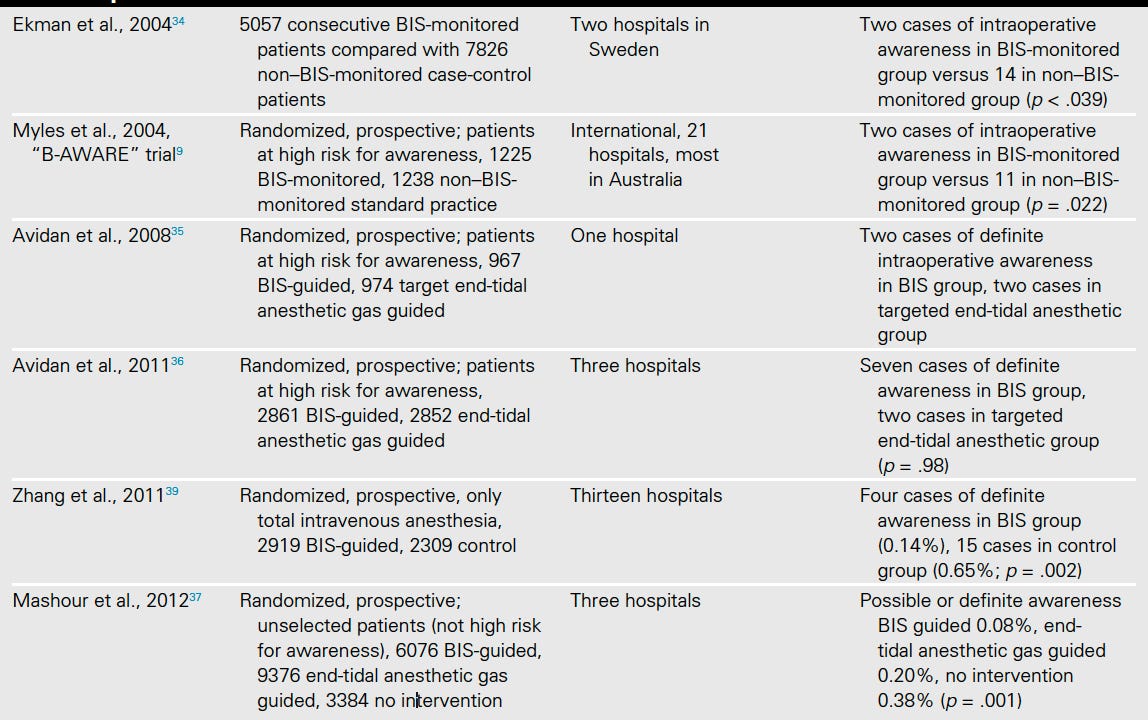
* Note that in both Avidan et al studies, BIS is compared to another intervention, “alarmed end-tidal gas analysis”, not “standard practice”. Thus these studies lack true control groups.
In addition, Dahaba et al found little effect of administration of mivacurium on BIS during propofol-remifentanil anesthesia with BIS between 40 and 50. Greif et al reported that BIS was not altered by mivacurium administration during administration of propofol to volunteers, again with BIS between 40 and 50. Similar results have been obtained in children.
Profound neuromuscular blockade is routine in the sugammadex era
Interestingly, we now find ourselves in an era with profound neuromuscular blockade being used routinely, due to the convenience of reversing profound rocuronium block with sugammadex. If neuromuscular block makes BIS (or Entropy) monitoring ineffective, we might expect an increase in cases of intraoperative awareness when BIS or similar monitors are utilized. Anecdotally this does not appear to be happening, but it might not be apparent without studies specifically directing at determining the incidence of intraoperative awareness.
Where do we go from here?
Despite the fact that Messner’s study is now 22 years old, the basic engineering problem and clinical significance of distinguishing EEG from EMG signals in processing computerized EEG data remains unsolved. EMG is often considered to be an artifact during BIS monitoring that can increase the BIS number; as such, neuromuscular blockade should improve the validity of the BIS index. However, Messner and Schuller argued that EMG is necessary for the BIS algorithm to obtain reliable results. These perspectives are difficult to reconcile. At the very least, it would be highly desirable to conduct a new clinical trial that determines the incidence of intraoperative awareness in patients undergoing surgery with and without BIS monitoring (or Entropy or Sedline monitoring), with profound neuromuscular blockade that lasts from induction of anesthesia until emergence. This is a study that could not have been done prior to the advent of sugammadex but could now be accomplished and would be highly clinically relevant.
Great stuff as always Andy. Very interesting and relevant. Thanks!